
CAFM & CMMS, reimagined

AI-Driven. Lower cost. Higher productivity.

Compliance · Cost · Completion. Graicx judges whether every site is meeting its statutory obligations, running cost-efficiently and delivering operations to plan, then shows why and what to do first.

Built for operators across
Housing associationsNHS trustsLocal authoritiesCommercial propertyHigher educationHospitality

Buildings break. Paperwork drifts.

From a cold flat to a lapsing certificate, an estate generates chaos daily. The chaos isn’t the problem. Not knowing is.

Platform

One system,
not seven spreadsheets.

Estate context, statutory rules, incoming demand and recorded work stay connected, so every site can be judged from one operational truth.

Milo assists throughout
01  Foundation
02  Controls & intake
03  Coordinated operations
04  Evaluation
Governance applies across every layer
  • Context
  • Operational flow
  • Governance / conditional

Many inputs. Connected operations. One operational truth. Select a module to trace its role. See how the machinery runs

Meet Milo

The assistant your estate
has been missing.

Milo is the facilities assistant built into Graicx. It reads every request the moment it lands, routes it under rules you set, drafts the paperwork, and answers questions about your sites in plain English.

Triage

Reads every request in seconds.

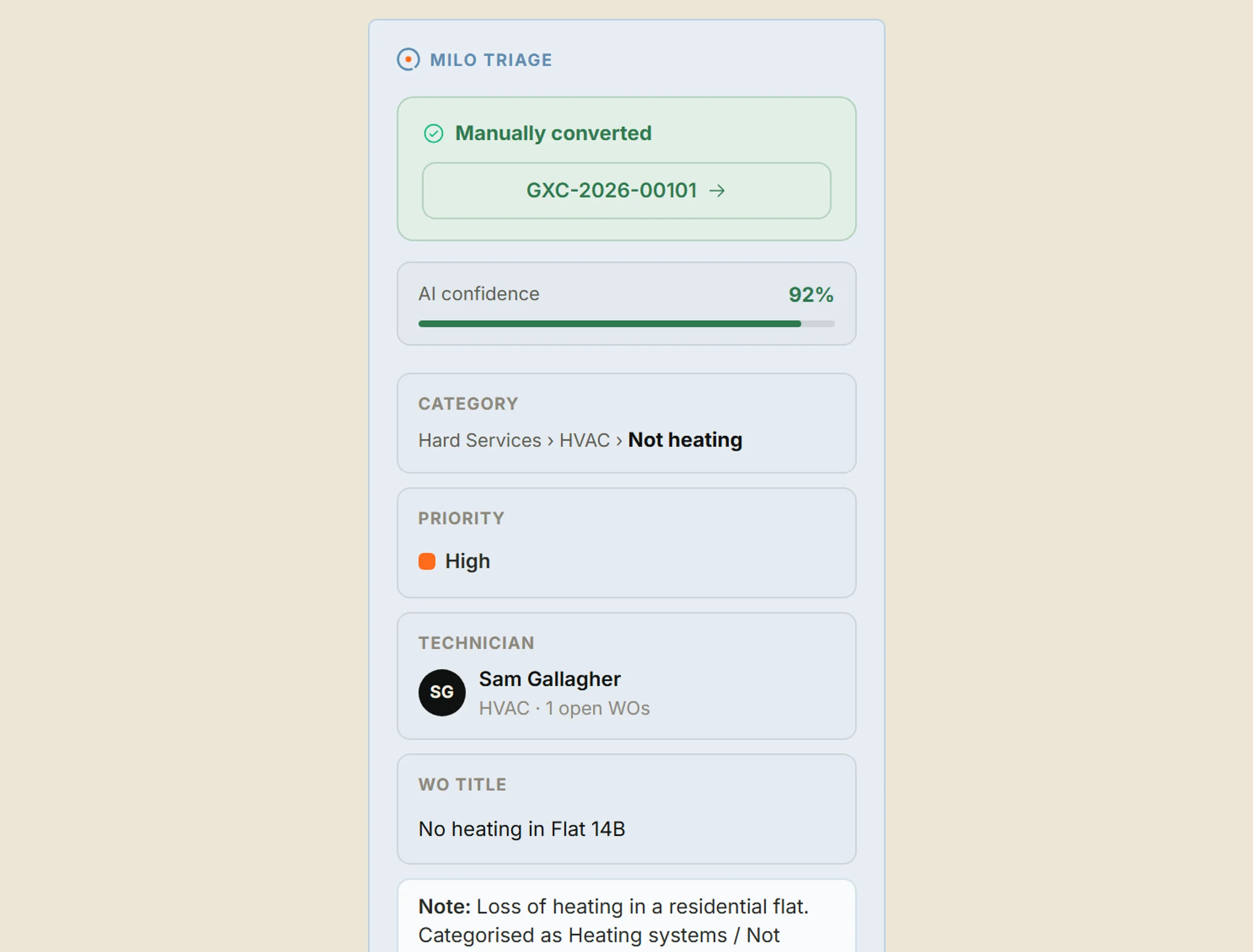
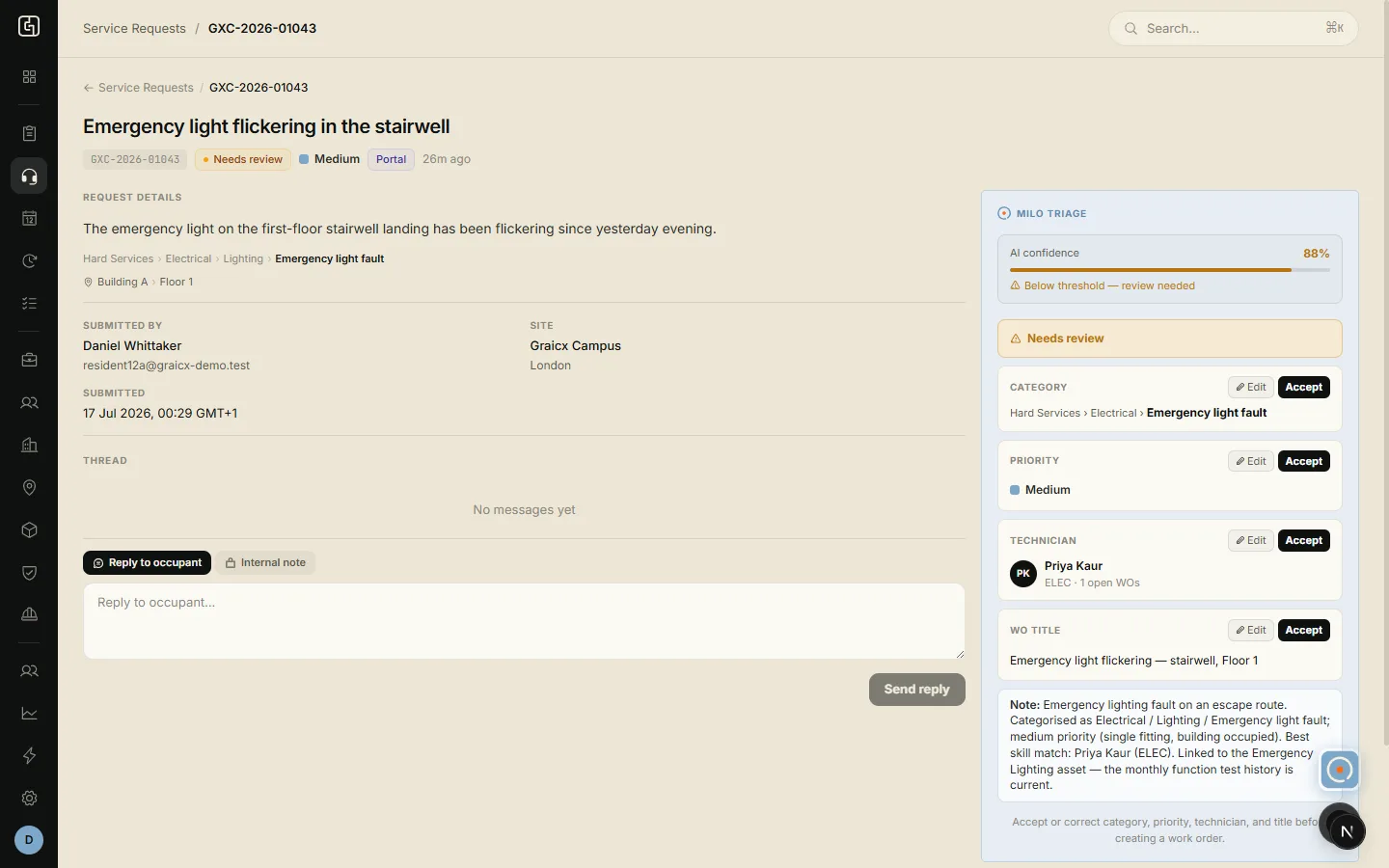
A resident’s message becomes a categorised, prioritised request before anyone opens an inbox: hazards flagged, duplicates spotted.

Ask

Ask your estate anything.

“Why is Graicx Campus at risk?” Milo answers from the verdict itself: the drivers, the records behind them, and what to do first.

Closeouts

Paperwork that writes itself.

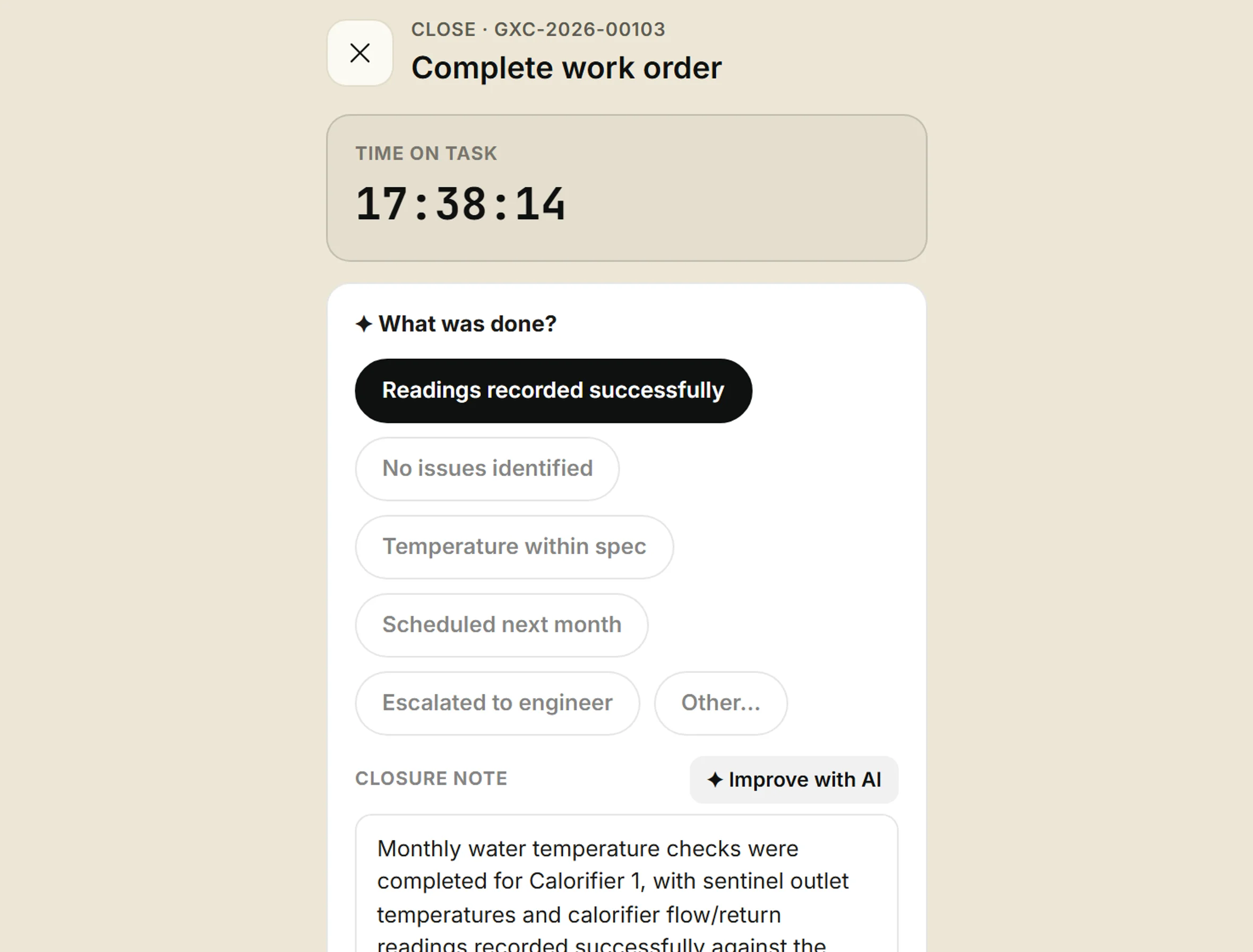
Photos, parts and time from the job card become a clean, evidenced closeout for the technician to approve, not retype.

Documents

Documents become data.

A scanned gas certificate becomes an asset record with the right expiry date, filed where the auditor will look.

Milo proposes. You set the rules. Every action is visible, attributable and reversible.How the rules work →
How it works

One request.
Zero phone calls.

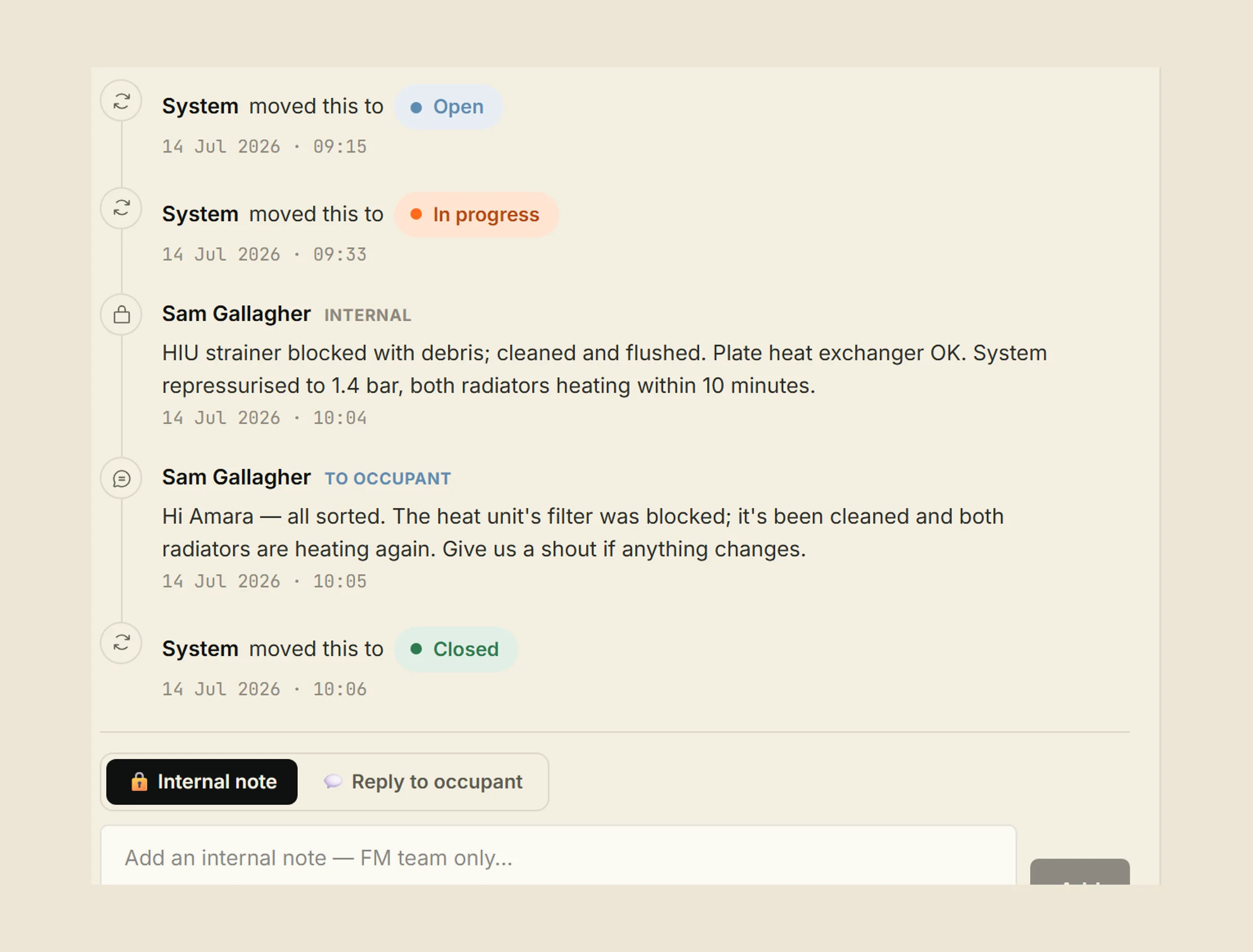
The story of one heating fault, from a resident’s message to a proven fix. Six beats, nobody chasing anybody.

01

Logged

A resident reports the fault from the portal. No call, no email chain.

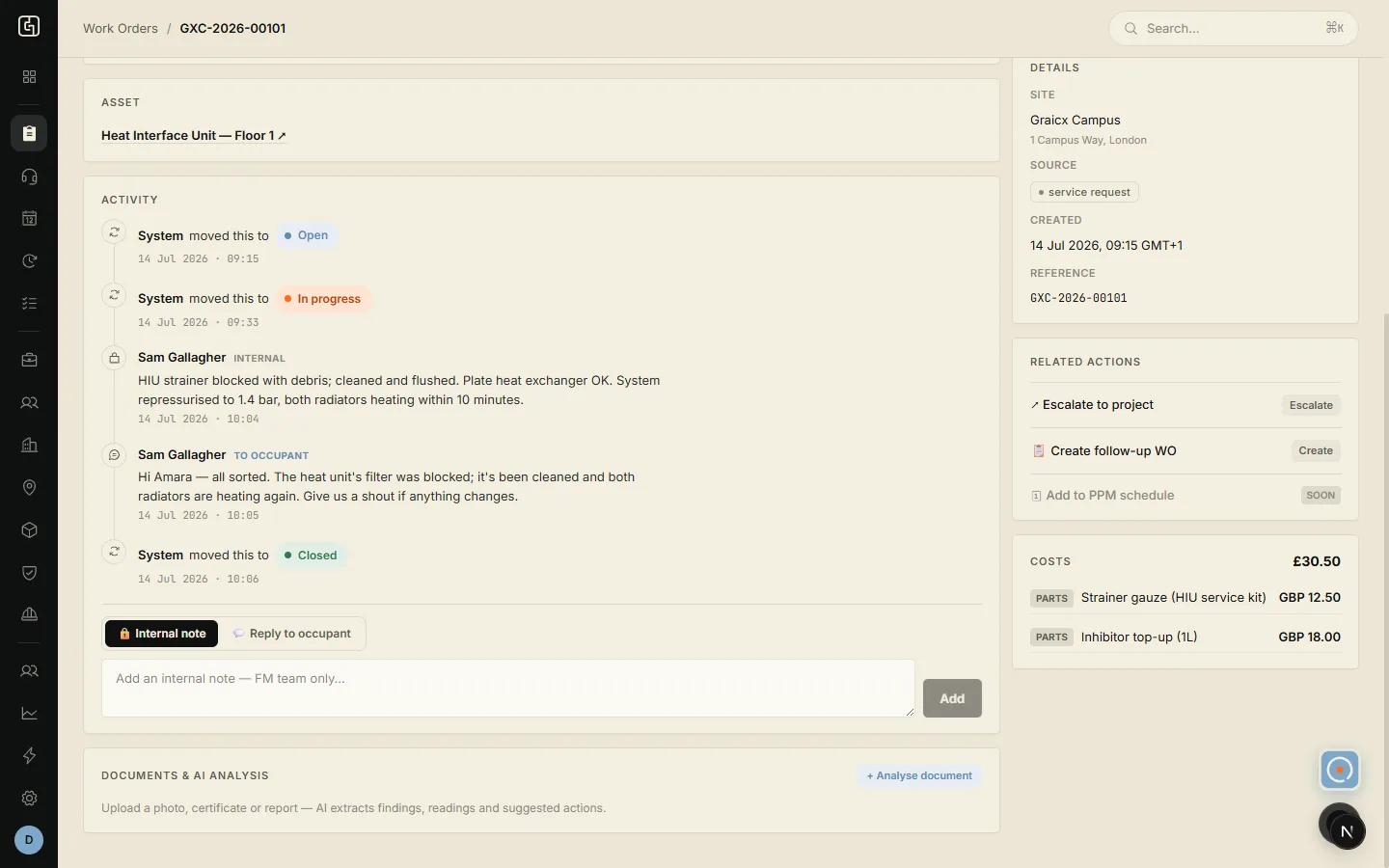
SR-1042 · logged 09:14
02

Triaged

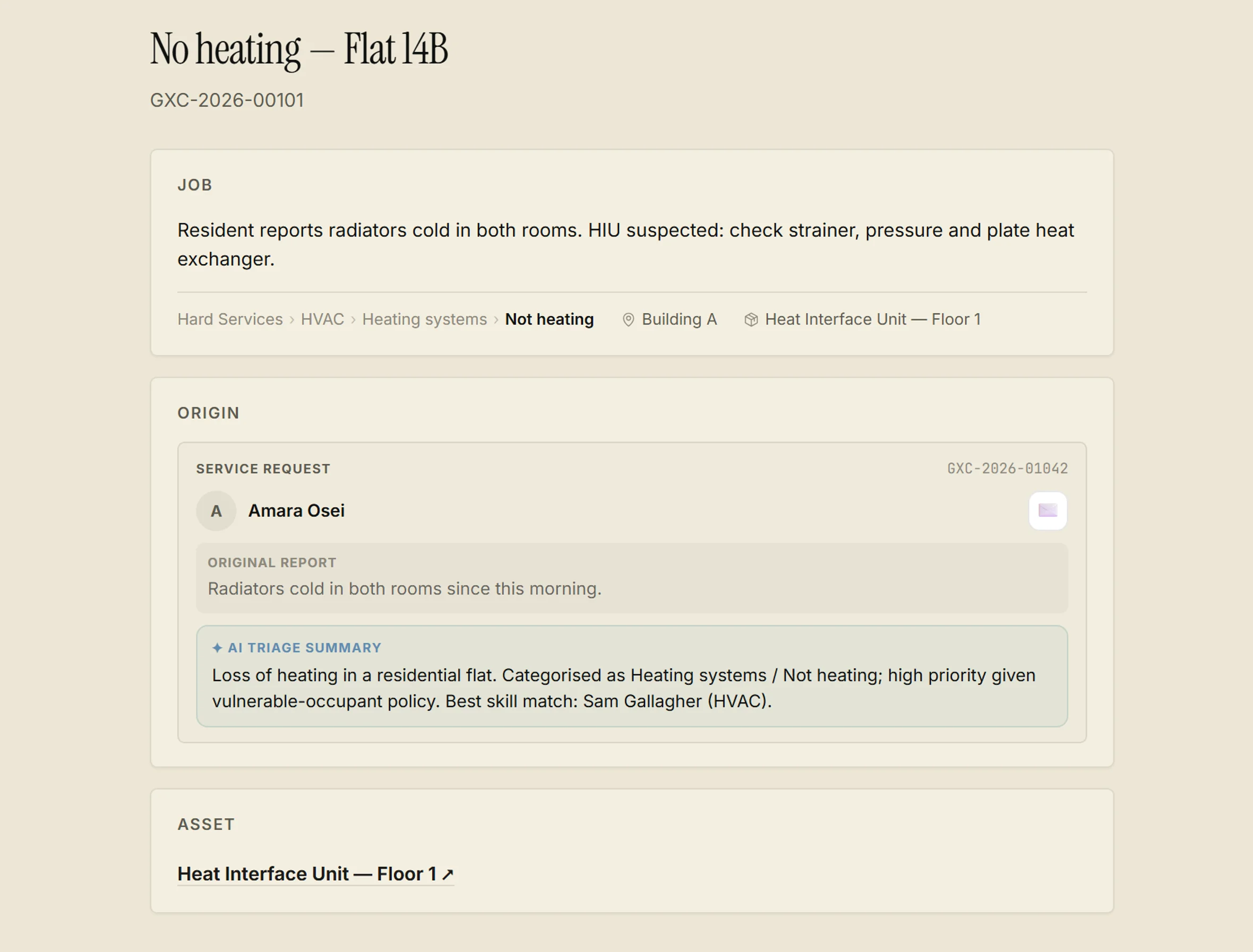
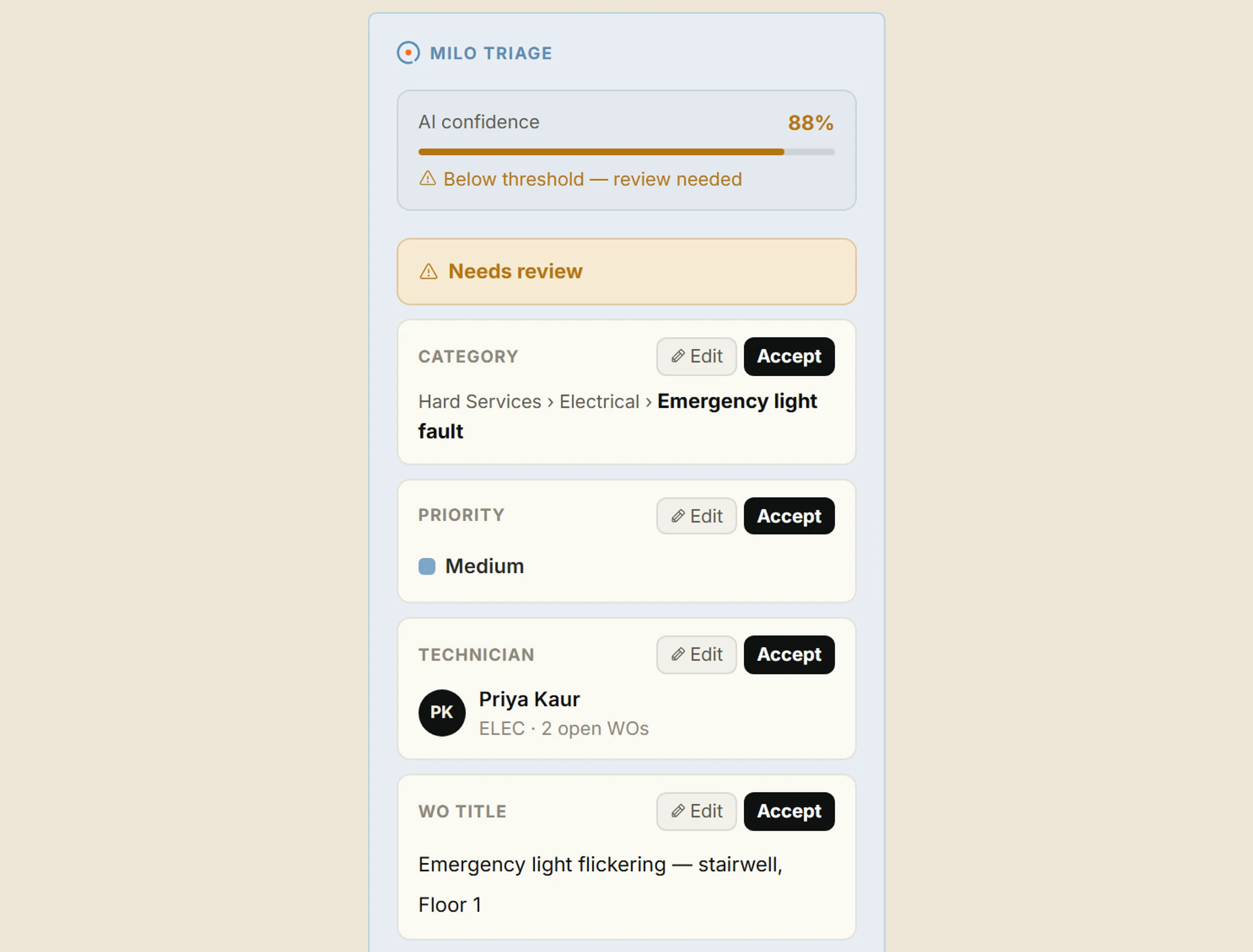
Milo reads it in seconds: category, priority and the best-skilled technician, proposed for approval.

Milo triage92% · Sam G.
03

Routed

Your rules decide what runs itself and what waits for a manager.

rulebook · manager approval
04

Dispatched

Sam’s day reshuffles around the job; travel gaps recalculate live.

GXC-2026-00101ETA 18 min
05

Evidenced

Photos, parts and time captured at the point of work.

2 photos · £30.50 parts
06

Proven

Closed inside SLA, evidence attached. The verdict moves with it.

resolved 10:06in SLA · 89 → 96
From request to resolved. And proven.Watch it in the demo tour →
Site health

3C Site Health.
The verdict and its reasons.

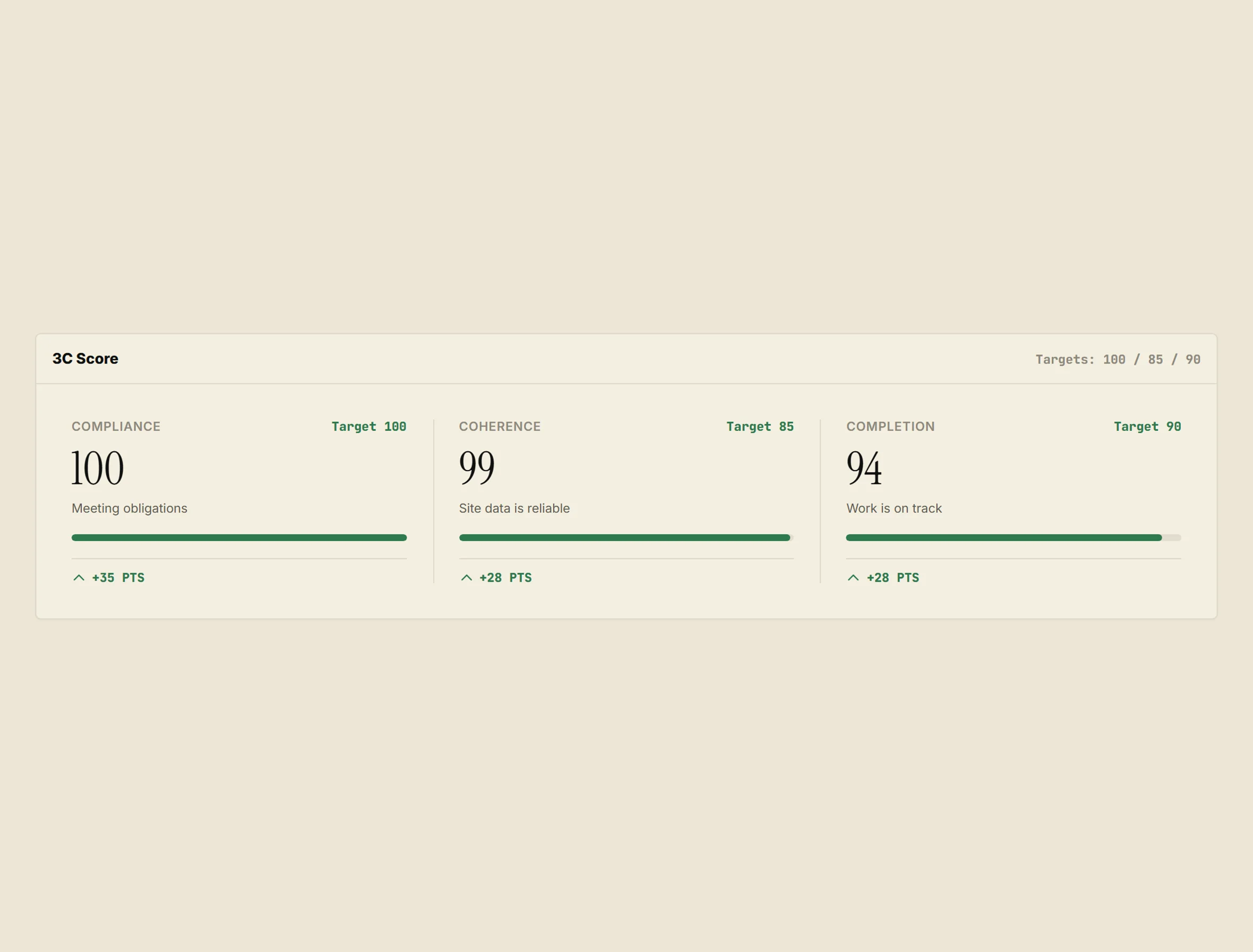
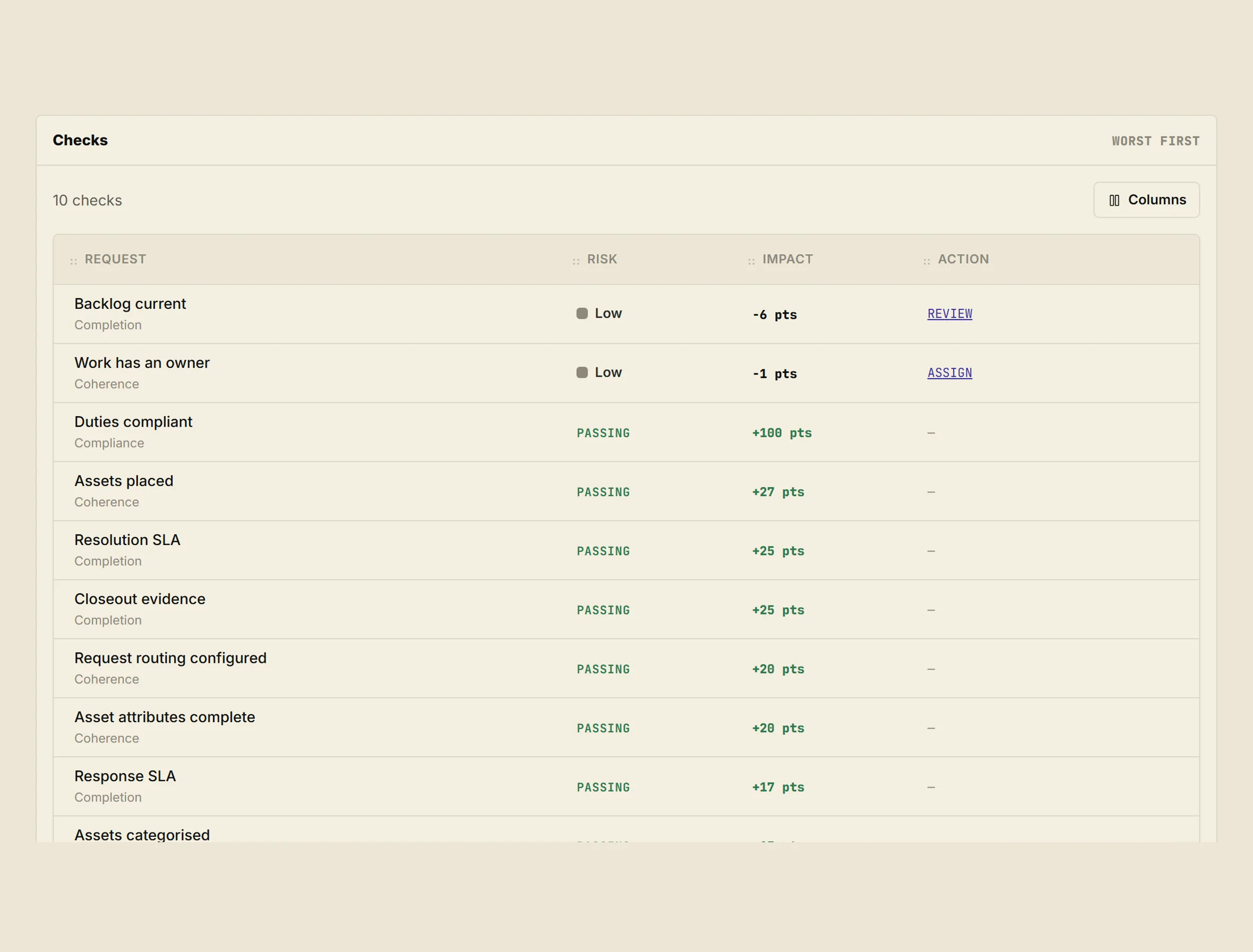
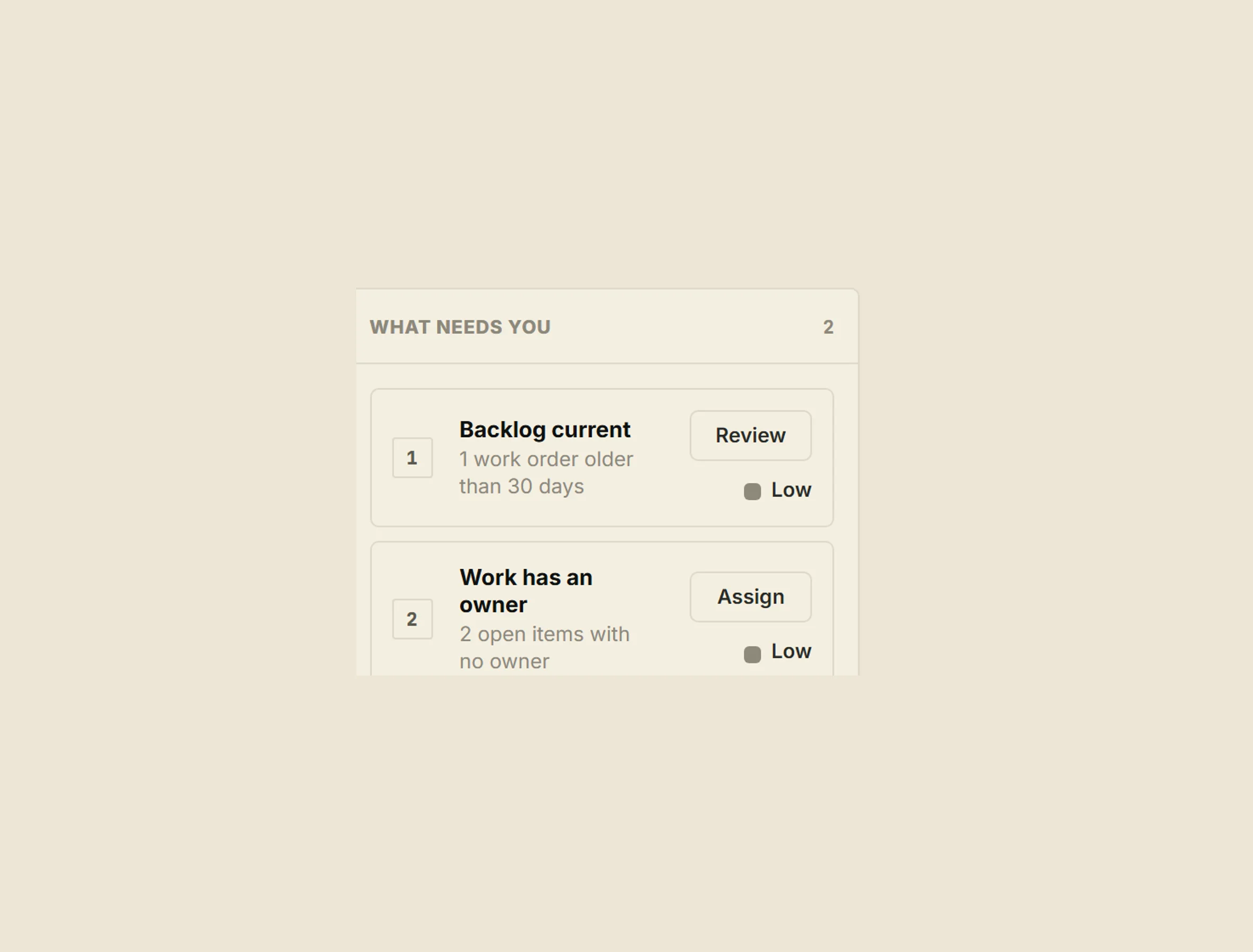
Compliance asks whether we are meeting our obligations. Cost asks whether the site is being maintained efficiently. Completion asks whether operations are running to plan. Graicx scores all three continuously, and ranks what needs you next.

Explore site health
100Compliance
99Cost
94Completion
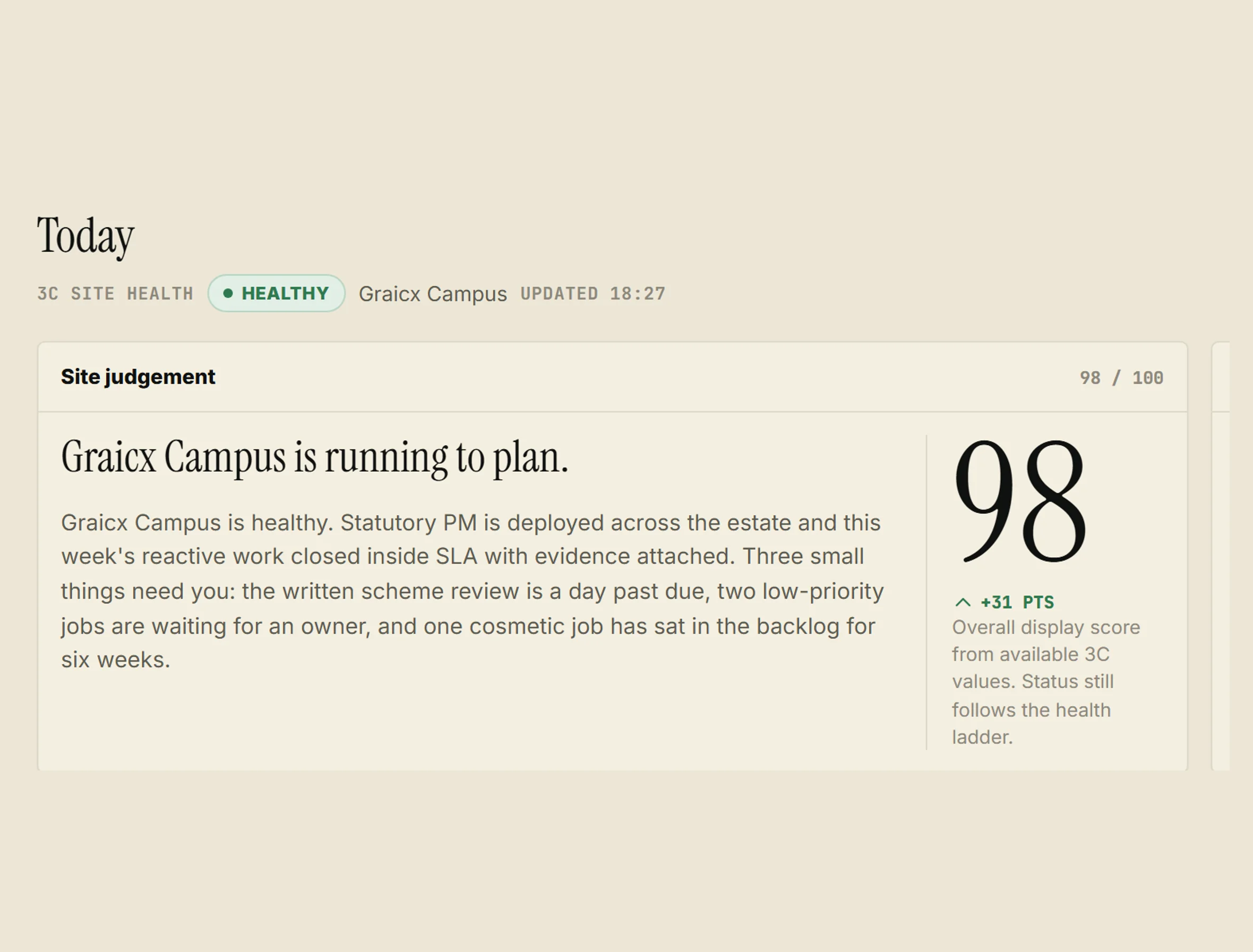
The site judgement card from the demo estate: Graicx Campus is running to plan, scoring 98.
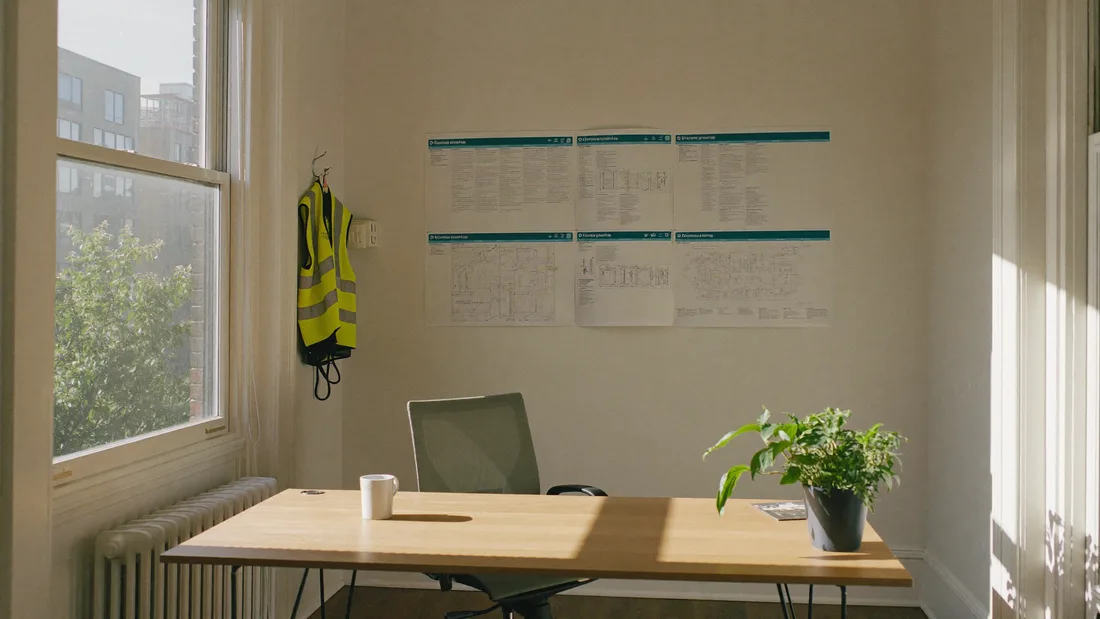
A sunlit facilities office in the morning: plans on the wall, hi-vis on the hook.
The estate answers before the phones start.COST · SPEND READ AGAINST PLAN
Work orders

Work lands done,
and proven.

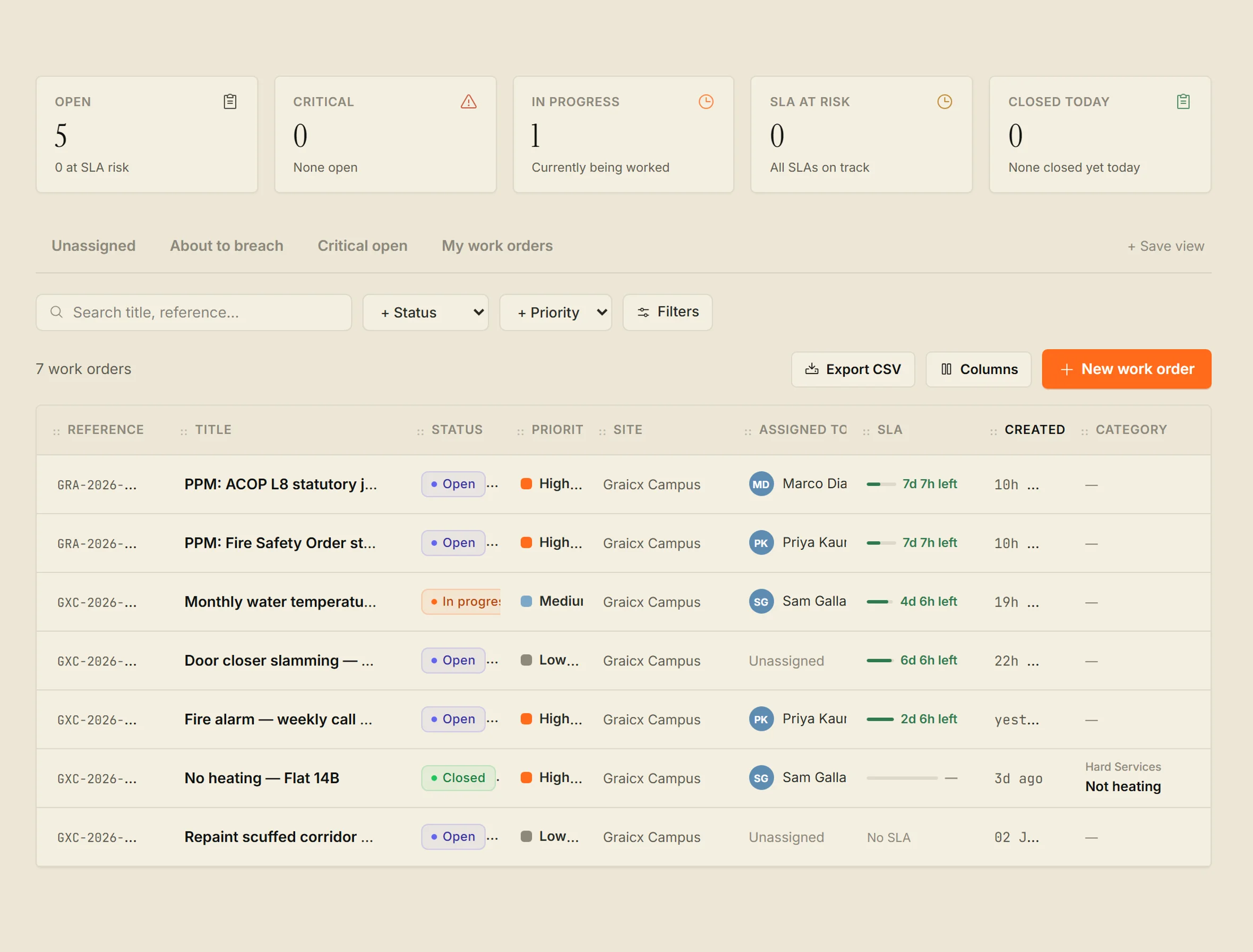
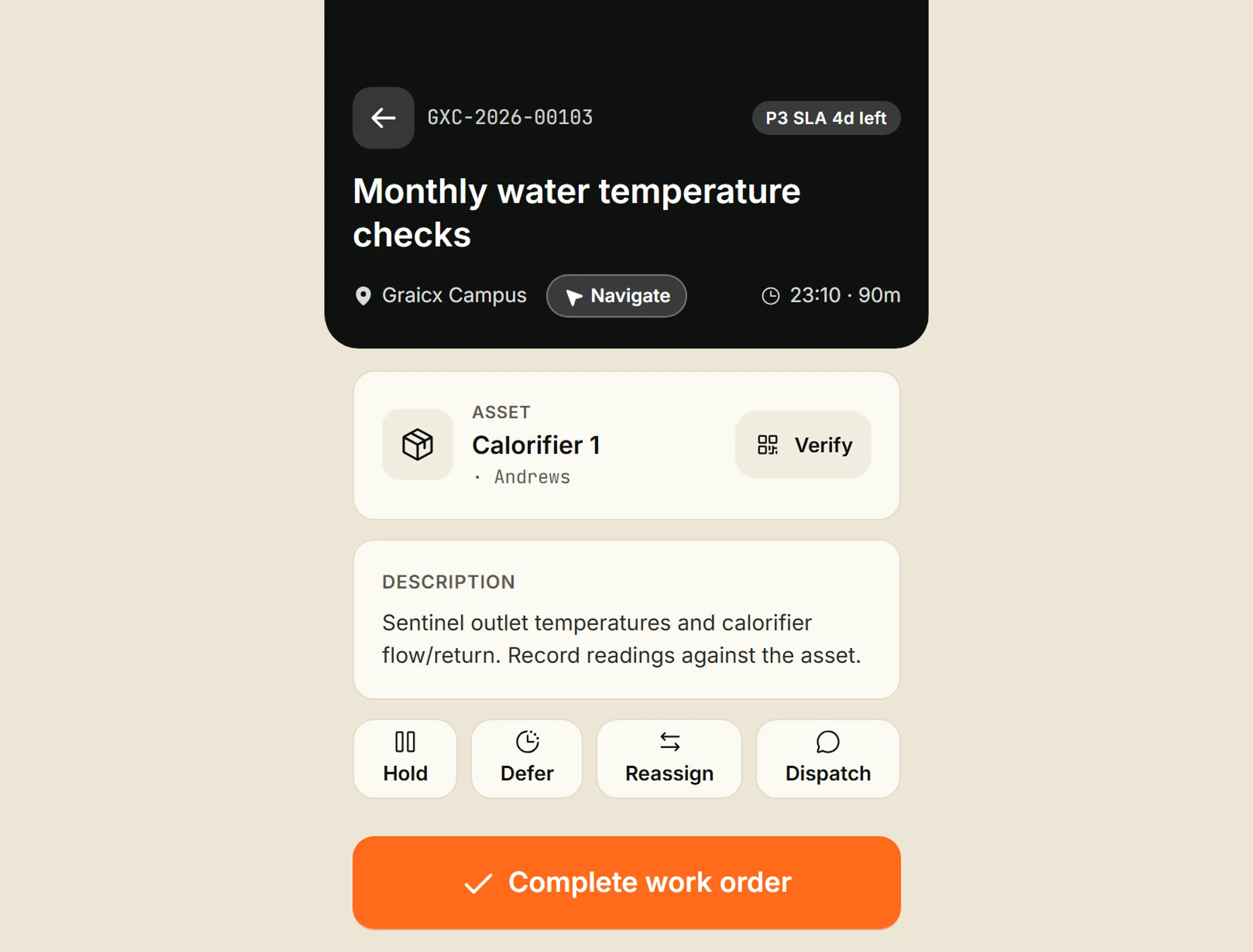
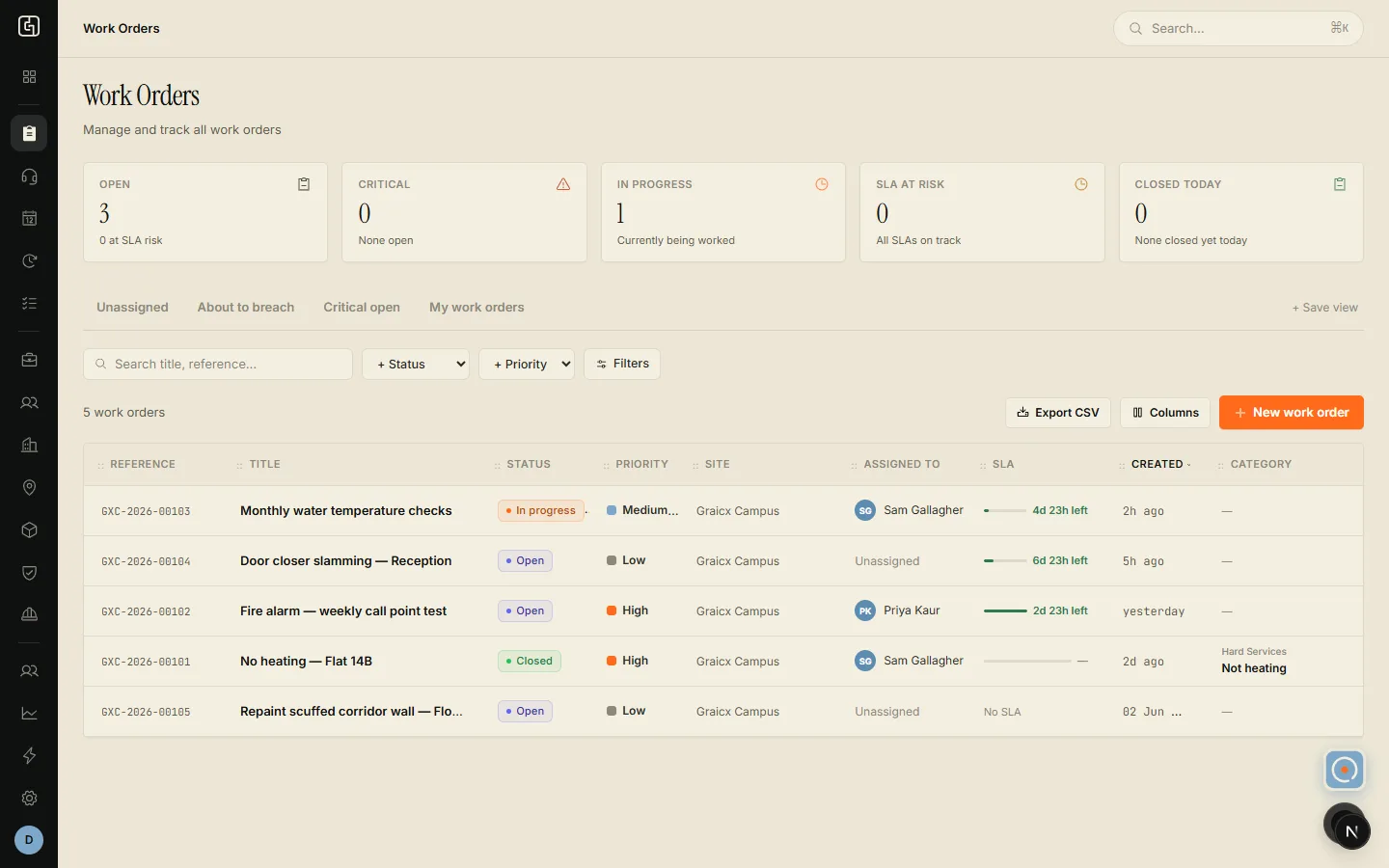
From a portal request to a closed job: dispatch by skill, travel and workload, SLA clocks that warn before they breach, and a closeout that captures photos, parts and time at the point of work, with the summary drafted for the technician to approve, not retype.

Watch it in the demo tour
The work order board from the demo estate: open, critical and SLA-at-risk counts above the queue with countdown clocks.
A technician crossing a rooftop plant deck on a bright morning, tablet in hand.
Closed on the roof. Proven in the record.GXC-2026-00108 · EVIDENCE ATTACHED
Compliance

Compliance that
survives an audit.

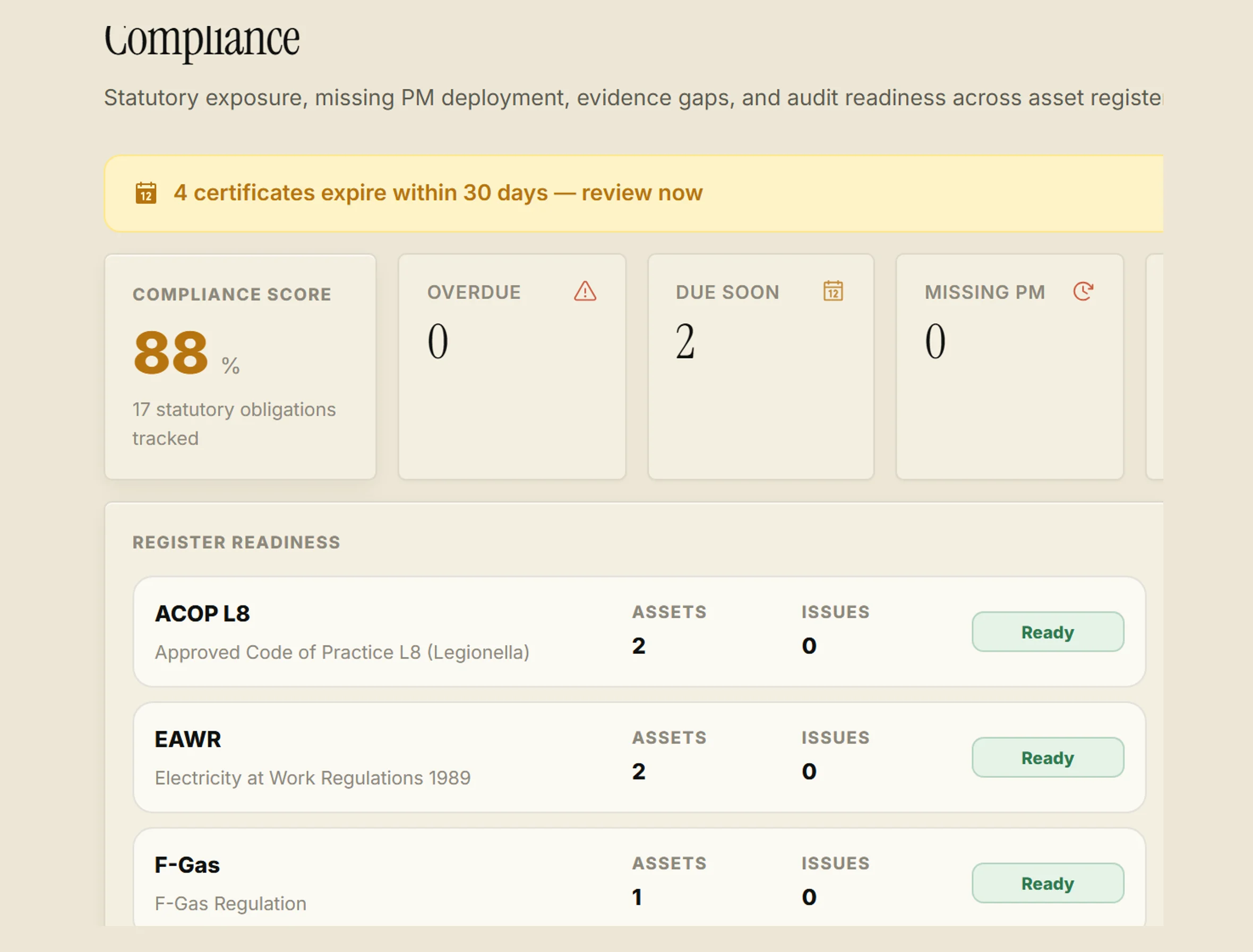
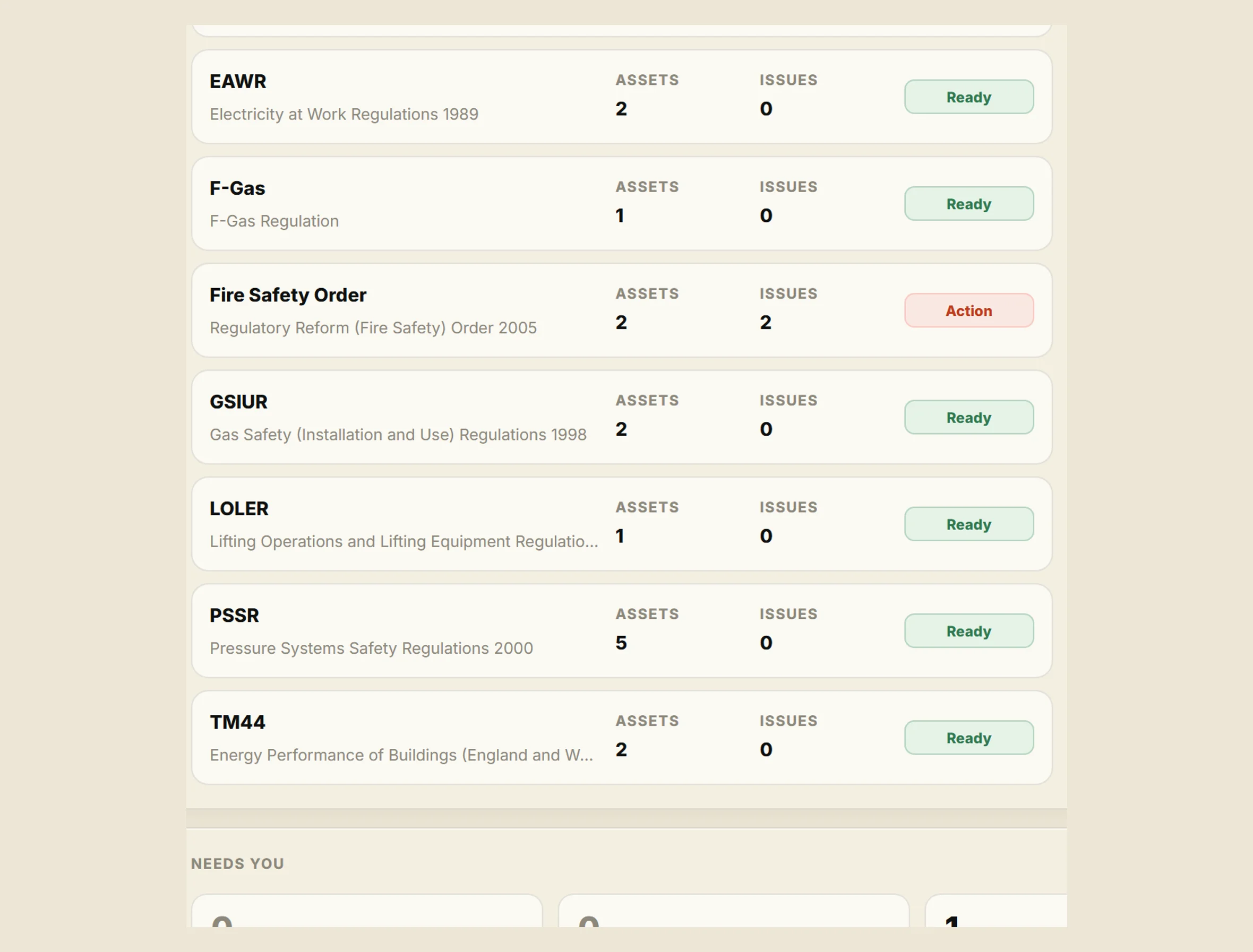
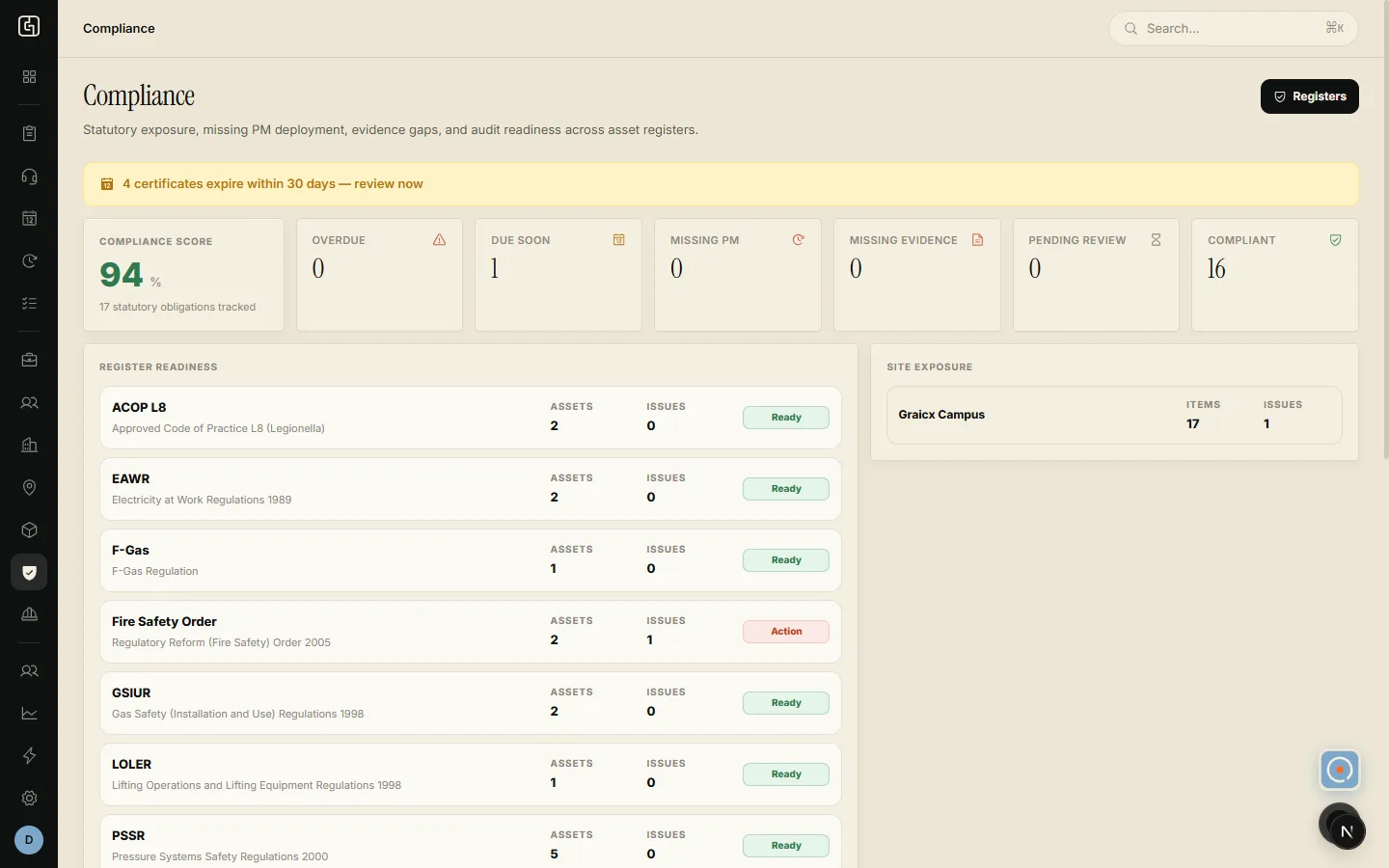
Your asset categories derive the statutory duties: the schedules, the checklist tasks, the governance actions. Evidence is accepted and dated against each duty, expiry is tracked, and the register shows exactly where you stand.

See compliance in depth
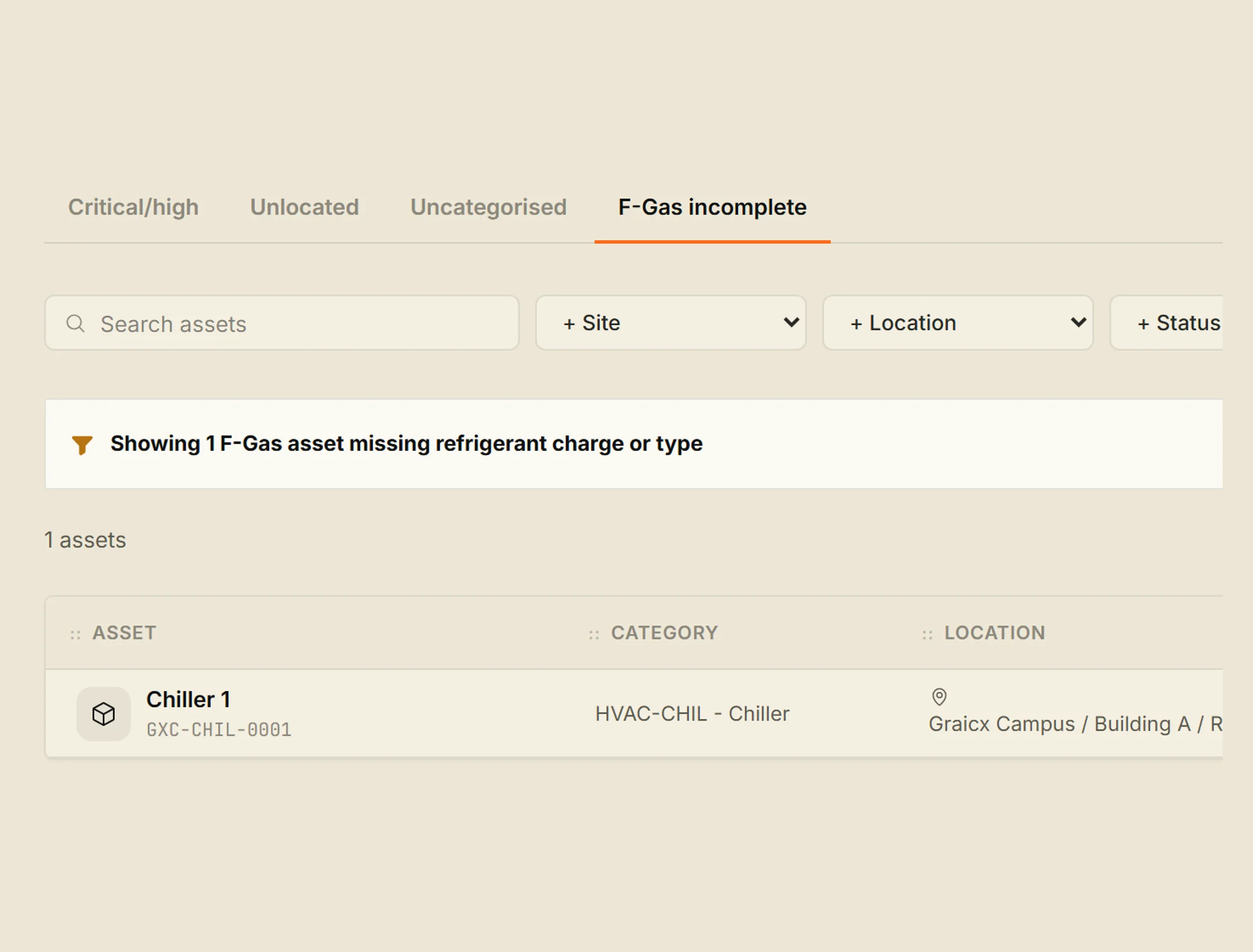
The compliance board’s score cards: 88% across 17 statutory obligations, with the certificate-expiry warning banner.
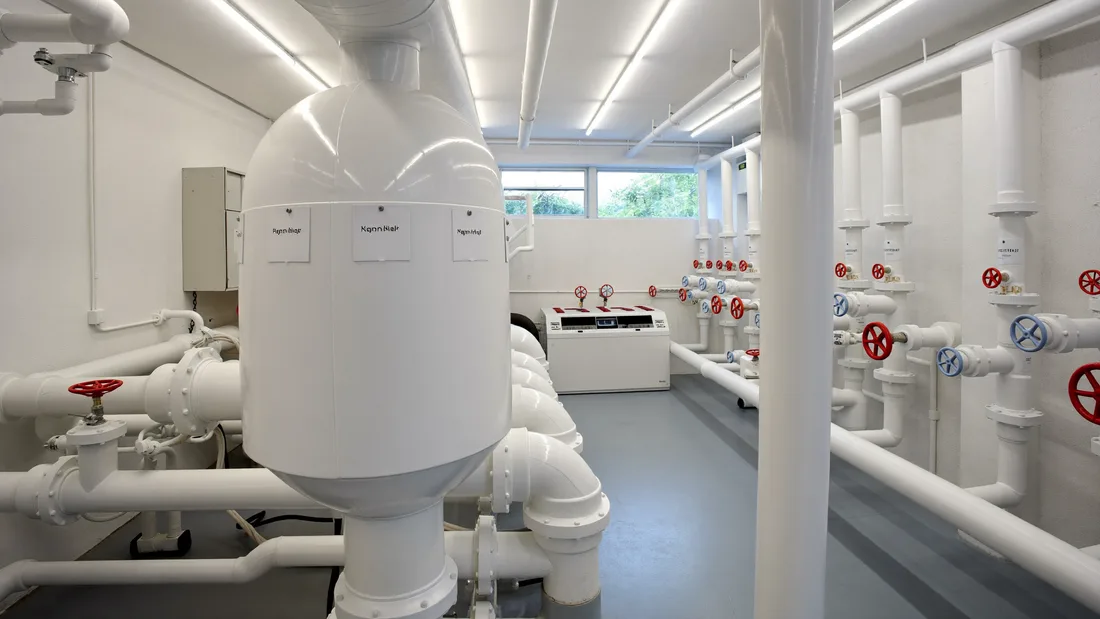
A bright, well-kept plant room: white pipework, red valve wheels, daylight from a high window.
The written scheme knows this room.ACOP L8 · REVIEWED · NEXT VISIT BOOKED
Service requests

From “no heating in 14B”
to a closed work order.

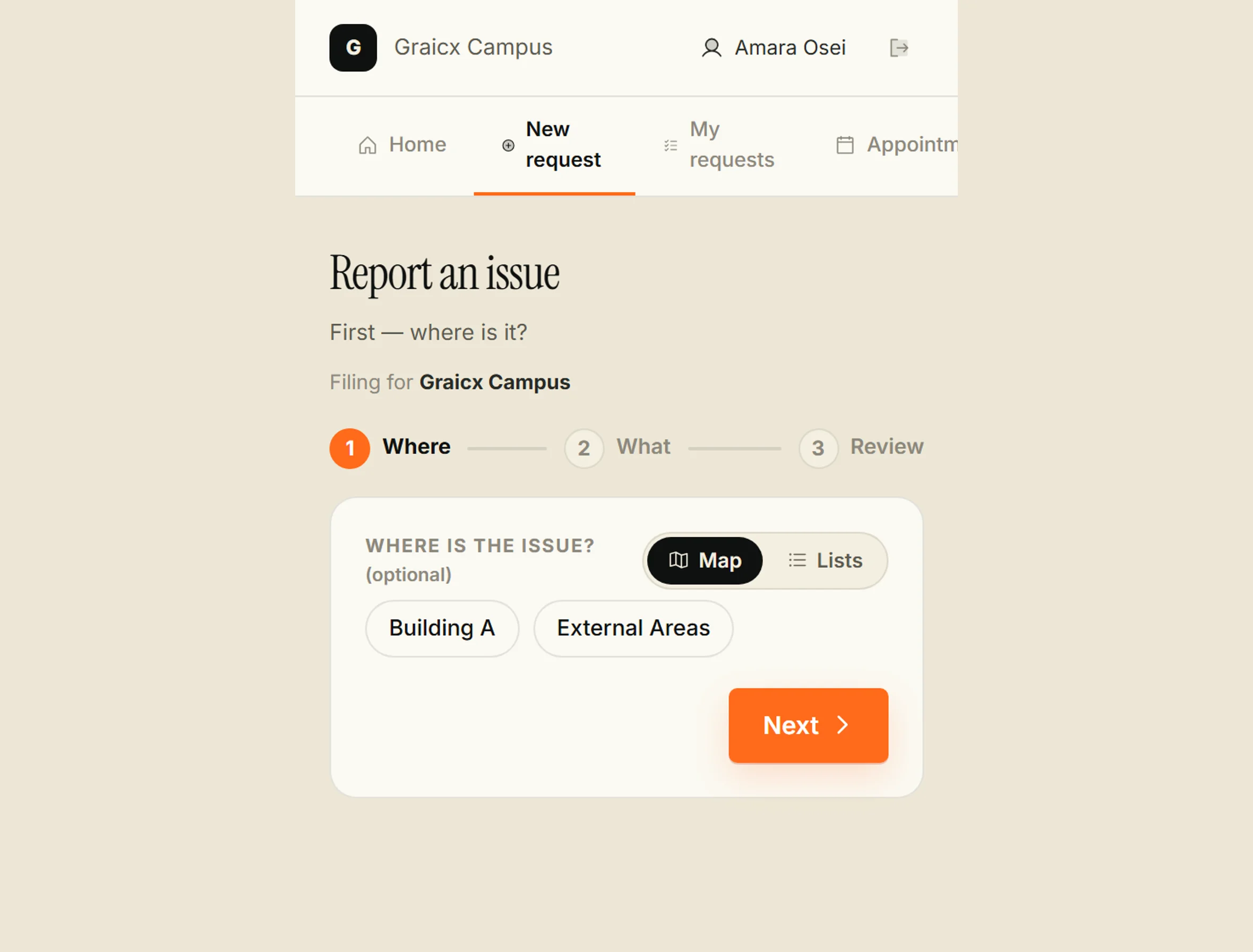
Occupants report issues in a simple portal: where, what, photos, done. Milo reads each request, scores the confidence of the read, and proposes category, priority and technician. Above your threshold it can convert straight to a work order; below it, a human reviews first.

Meet Milo
The occupant portal on a phone: “Report an issue”, with the where–what–review steps and the building picker.
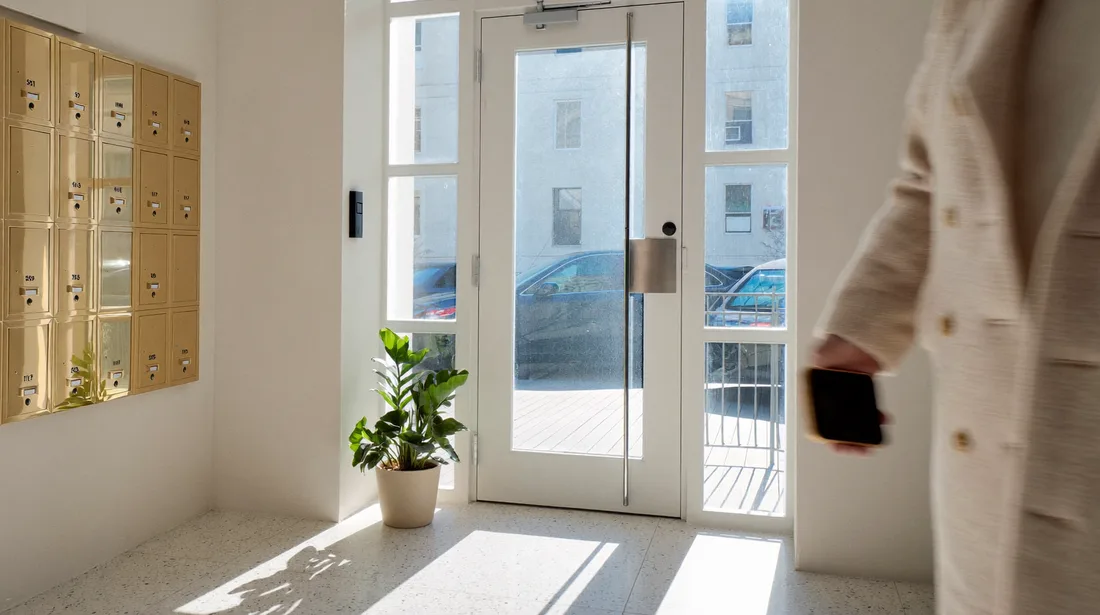
A sunlit residential lobby: a resident passing the letterboxes, phone in hand.
Cold at nine. Warm by eleven.GXC-2026-01042 · CONVERTED · CLOSED SAME DAY
See it working

Real screens,
not renderings.

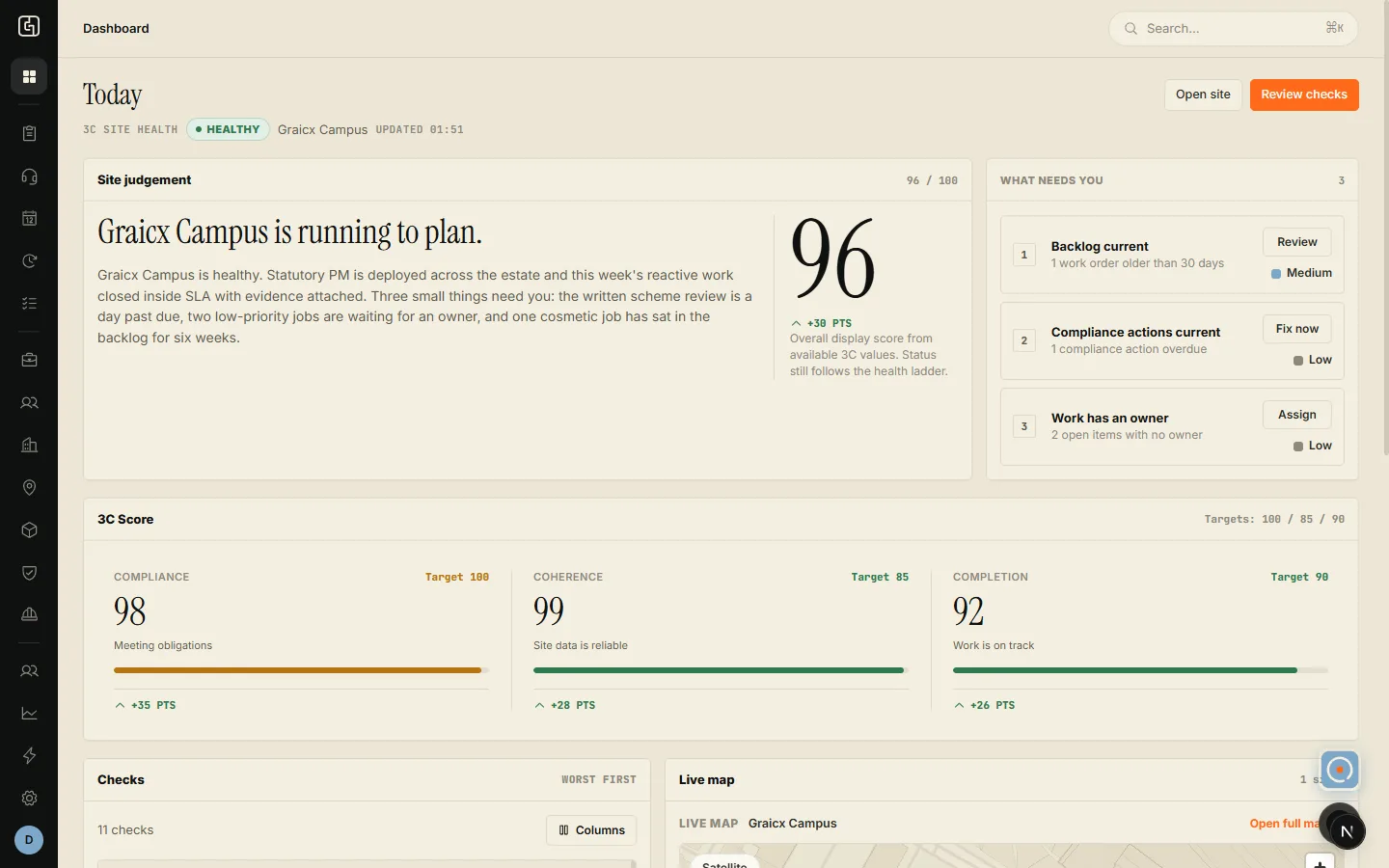
Five frames captured from a live Graicx tenant seeded with a fictional estate. Real product pixels; invented data. The rest we’d rather show you in person.

Graicx dashboard showing Graicx Campus healthy at 96 out of 100, with the three C scores and a what-needs-you queue.
The verdict

One verdict per site.

Compliance, cost and completion scored from the records themselves, with a queue of exactly what needs you.

The backbone

Your policies,
not a black box.

Milo reads and routes, but the platform runs on rules you can open and inspect. Workflow rules, statutory compliance and on-site risk assessment are deterministic, transparent and entirely yours to configure.

Rules engine

Your rules, enforced automatically.

Decide how every request is handled with plain if-this-then-that rules: by source, site, priority, category and more. Set it once at account level, then override per client or per site. No code, no developer, no ticket.

  • Conditions on 14+ fields, eight actions: route, hold for review, auto-create, reject, tag and more
  • Three-tier scope: account → client → site, with inheritance you can see
  • Auto-create and auto-assign work orders, or keep a human in the loop: your call
Explore workflow rules
Compliance engine

Compliance that can’t slip.

Statutory requirements map straight onto your assets and maintenance schedules: FGAS, LOLER, Legionella, fire, gas, electrical, PAT and more. Evidence is captured at the job, expiry is tracked, and a deadline escalates before it becomes a breach.

  • Requirement status (compliant, due soon, overdue, missing) computed for you
  • Evidence captured against the asset at point of work, never filed after the fact
  • Failed checks escalate to managers; auditors get scoped read-only access
See compliance in depth
Dynamic Risk Assessment

Safe to proceed, on the record.

Technicians complete a job-specific risk assessment before they start. Context cards pre-fill from the asset, the job plan and the reported hazards; serious flags and stop-work decisions escalate to a manager and stay fully auditable.

  • Templates resolve by job plan → asset category → service category → account default
  • No work order goes in-progress without a current “safe to proceed” for that technician
  • Controls, acknowledgements and photos captured per question
How DRA works
Where we are

Early, and
honest about it.

Graicx is a young platform, built alongside pilot estates rather than sold past them. We publish the targets we model at onboarding, baseline your current state in week one, and report against it monthly in a dashboard you can see. When our first customers are ready to speak publicly, you will hear it from them, not from us.

Pricing

Price by estate
or by user.

A flat fee set by your site size. Everyone logs in at no extra cost: engineers, cleaners, subcontractors and managers alike. No seats to count.

Small site

A single site getting organised.

£643/ mo · billed annually
  • Up to 500 assets
  • Unlimited users, any role
  • 300 Milo chats + 100 document analyses / mo
Book a demo

Medium site

A growing estate with headroom.

£919/ mo · billed annually
  • Up to 2,000 assets
  • Unlimited users, any role
  • 750 Milo chats + 250 document analyses / mo
Book a demo

Large site

A large site or a campus.

£1195/ mo · billed annually
  • Up to 4,500 assets
  • Unlimited users, any role
  • 1,500 Milo chats + 500 document analyses / mo
Book a demo

Enterprise

Portfolios across many addresses.

Custom
  • Unlimited assets · multi-site
  • Unlimited users, any role
  • Pooled Milo allowance across sites
Talk to sales

Enterprise adds: portfolio pricing across sites · named customer success manager · bespoke onboarding & migration · security review, DPA & procurement support.

A site is one continuous location at a single address: a building, a block, or a whole campus. Separate addresses are separate sites, and portfolios of them are Enterprise.

Unlimited users of every role, whatever the site size · Milo triage, closeout assist, dispatch & notifications included as standard · pay only for Milo chat & document analysis beyond your monthly allowance. Prices exclude VAT.

Whichever you pick, the platform is the same one.

What you get

One plan.
The whole platform.

There is no upgrade path here, because there is nothing to upgrade to. Compared against the premium package the market normally sells, not its entry plan. The last group is where others are stronger, because you would find it in the first demo anyway.

Graicx compared with the premium package mainstream CMMS and CAFM tools typically sell
FeatureGraicxOthers’ premium offer
Site intelligence
One health verdict per site (3C Site Health)IncludedNot included
Ranked drivers, each linked to its fixIncludedNot included
Continuously recomputedIncludedNot included
UK statutory compliance
Computed duties: F-Gas, LOLER, Legionella, fire, Gas Safe, electrical, PATIncludedNot included
Evidence captured against the asset at point of workIncludedNot included
Expiry tracked, escalates before breachIncludedNot included
Dynamic Risk Assessment gates unsafe workIncludedNot included
Work & field
Reactive work orders and planned maintenanceIncludedIncluded
Travel-aware smart dispatch (skill, distance, workload, shown)IncludedNot included
Mobile field app, no app-store download, offline-tolerantIncludedNot included
Data-collection rounds that auto-raise work ordersIncludedNot included
IoT devices, readings and alertsIncludedNot included
Occupants & requests
Branded occupant and resident portal, no downloadIncludedNot included
Self-service appointment booking and rescheduleIncludedNot included
Automatic status notificationsIncludedIncluded
AI: Milo
AI triage on every request, confidence-scoredIncludedNot included
Draft closeouts and document-to-recordIncludedNot included
Your rules decide what runs automaticallyIncludedNot included
Reporting, control & security
Insights and reportingIncludedIncluded
Workflow rules across account, client and siteIncludedNot included
Multi-site managementIncludedNot included
SSO, role-based access and audit logIncludedNot included
Commercial
One plan, whole platform, no feature gatesIncludedNot included
Choice of pricing model, by estate or per userIncludedNot included
Free onboarding and data migrationIncludedNot included
UK and EU hosting as standardIncludedNot included
Where others are stronger
Quoting, contract billing and client invoicingNot includedIncluded
Accounting integrations (Sage, Xero, QuickBooks)Not includedIncluded

“Others’ premium offer” reflects the premium package mainstream CMMS and CAFM tools typically sell as of July 2026, not any one product. A cross means a premium buyer does not get the line on the left: it may be held back for an enterprise agreement, sold as a separate add-on, or answered by something adjacent that does a different job.

Questions

What buyers
ask us first.

Anything not covered? We answer in writing, within two business days: security questionnaires, data processing agreements, architecture diagrams.

  • Compliance asks whether we are meeting our obligations. Cost asks whether the site is being maintained efficiently. Completion asks whether operations are running to plan. Graicx measures all three continuously and combines them into one health verdict per site (Healthy, At risk or Critical), with the records behind every score one click away.

  • Both, in practice. Graicx covers the CMMS ground (work orders, planned maintenance, asset registers, mobile engineers) and the CAFM ground (statutory compliance, occupant self-service, reporting) in one platform. What neither label captures is the judgment layer: 3C Site Health reads all of that activity and tells you whether each site is actually healthy. If you are searching for a modern CMMS or CAFM alternative, this is that.

  • Milo is the AI assistant built into Graicx. It triages every incoming request under rules you control, helps technicians close out jobs, reads documents into structured records, and answers questions about your sites in plain English. Milo proposes; your rules and your people decide.

  • You choose one of two models, and both carry the whole platform. By estate is a flat monthly fee set by the number of maintainable assets on a site, and it includes unlimited users of any role: engineers, cleaners, subcontractors and managers all log in at no extra cost, with no seats to count. Per user is a single rate for everyone who works in the platform, technicians included, with requesters and occupants free. Estate pricing usually wins for in-house teams with a lot of people on the tools; per user usually wins for service providers and smaller teams. Both are billed monthly or annually, and annual saves 8%. Prices exclude VAT.

  • Four weeks from kickoff to first team live is typical. Week one: we configure your account, import your asset register and set up user access. Weeks two and three: your coordinators learn the scheduling tools and your techs are onboarded to the mobile app. Week four: you run live with us alongside for any questions. Larger estates roll out building-by-building on the same cadence.

  • When a work order is created, Graicx scores every available technician against three factors simultaneously: whether their skills match the job category, how far they are from the site, and how many jobs they already have. The highest scorer is suggested, or dispatched automatically if auto-assign is enabled. You can always override. The scoring is transparent: every suggestion shows you exactly why.

  • Residents access a branded portal (no app download required) where they can raise maintenance requests, see the status of open jobs, choose an appointment slot from your real-time availability, and reschedule if needed. Every status change sends them an automatic email notification. It works on any device and is designed to reduce inbound helpdesk calls significantly.

  • Yes. The technician app is a mobile-optimised web application that loads on iOS and Android without an App Store download. It is designed for field conditions: large tap targets, minimal input, offline-tolerant job capture. Photos, notes and time entries sync when connectivity returns.

  • Every captured action (inspection reading, photo, signature, parts used) is stored against the asset with a timestamp and the user who captured it. There is no manual filing step. Compliance dashboards show coverage by regime in real time. Auditors can be given scoped read-only access, and you can export a complete evidence package for any asset, site or date range on demand.

  • The parts are designed to work as one system, configured once. A service taxonomy with per-site scope decides which work is covered where, and routes it to the right skills. Workflow rules decide what happens to each request, including holding it for a person; workflow policies set how much runs itself, from AI triage thresholds to auto-assignment, right down to site level. Dynamic Risk Assessment gates work until it is safe. The compliance studio keeps statutory obligations current. Data-collection rounds and IoT readings keep the record honest, the live site map takes you from estate to building to floor, and technicians earn real progression as they work, which keeps the data flowing in. Once that is set, the site largely runs itself, and 3C Site Health tells you it is running.

  • Yes, in two ways. You can tighten the statutory baseline where your organisation demands more, through a reviewed overlay process, and you can decide exactly who owns a failure: routing rules at account, client or site level send a failed check to the right manager as an action or a follow-up work order. The exact derivation model is ours, but the result is never a black box: every obligation shows its status and the records behind it.

  • Yes. We have a migration kit that handles standard shapes: assets, locations, work orders, planned maintenance schedules, vendors and parts. Most customers come from spreadsheets or a legacy CMMS. We map your data, run a dry-run preview so you can check it before anything goes live, and import it together. Your historical data comes with you.

See Graicx on your estate.

Send us your current process: a spreadsheet, a screenshot, a description of what breaks every Monday morning. We'll show you a working prototype on your data within a week. No contract required, no consultant jargon.

No obligation. We sign your NDA. Your data never leaves a UK or EU region.